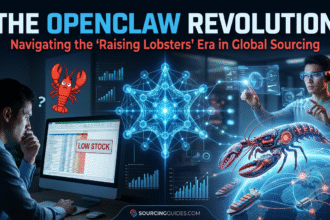

“The era of corporate communication defined by manual email chains and rigid data silos is officially coming to a close as interoperable digital minds take over the daily mechanics of commerce.”
The End of Transactional Friction in Global Sourcing

For global B2B procurement managers, the daily reality is rarely defined by grand strategic visions; instead, it is consumed by the relentless friction of manual communication. The typical buyer spends half their week trapped in high-frequency, exhausting communication loops, chasing factory production updates, reconciling varying pricing tiers over messy email threads, and verifying shipping delays across multiple uncooperative logistics platforms. This transactional noise has long been accepted as the inevitable tax of international trade. However, the tech landscape has shifted underneath the supply chain. Following Google I/O 2026, the tech giant officially declared the dawn of the Agentic Era, unveiling a massive structural overhaul designed to replace these fragmented, manual touchpoints with fluid, autonomous, cross-platform interactions. At the heart of this transformation is a move away from passive chatbots that merely answer questions toward universal AI agents capable of executing complex, multi-step workflows natively across different enterprise ecosystems.
Breaking Down Inter-Enterprise Silos with the A2A Protocol
For B2B buyers, the most consequential breakthrough from Google’s recent showcase is the widespread production deployment of the Agent2Agent (A2A) protocol. Historically, the biggest barrier to supply chain automation has been systemic isolation, meaning a buyer’s enterprise resource planning system could not naturally communicate with a foreign manufacturer’s proprietary factory software without expensive, custom-built electronic data interchanges. The A2A protocol solves this by establishing an open, interoperable linguistic standard that allows disparate AI agents from different vendors to securely talk to one another, cross organizational boundaries, and delegate tasks without human intervention.
Automating Complex Mid-Production Adjustments in Real-Time
To visualize how this fundamentally alters daily procurement operations, consider the standard nightmare of a mid-production order amendment. Under the legacy model, a buyer wishing to alter a component specification must email the account manager, who then pings the factory floor manager, who checks material availability, manually recalculates the unit cost, and replies days later with an adjusted proforma invoice. In the newly minted ecosystem powered by Gemini 3.5 Flash and integrated enterprise networks, the buyer simply voices the requested change to their local workspace agent. This buyer-side agent instantly translates the intent, connects directly via the A2A protocol to the factory’s internal scheduling agent, verifies raw material capacity within an isolated cloud partition, updates the financial ledger, and presents a finalized contract amendment for human digital signature in seconds.
Shifting from Industrial Pilots to Scaled Operational Realities

This hyper-efficient automation is already leaking into industrial realities. Industrial manufacturing pioneers like Danfoss have utilized early iterations of Google’s managed agent framework to tackle the swamp of email-based order processing, successfully automating roughly eighty percent of transactional decisions and reducing supplier response times from forty-two hours to near real-time. By utilizing the Gemini Enterprise Agent Platform, companies can deploy autonomous sub-agents that continuously scan incoming logistics data, cross-reference supplier capacity, and execute background micro-negotiations over minor inventory discrepancies. This means high-frequency, low-margin friction loops vanish from a buyer’s daily to-do list entirely.
Preserving Corporate Security within Dedicated Cloud Boundaries
Crucially, Google’s overhaul ensures that security and data privacy are treated as core architectural pillars rather than operational afterthoughts. Buyers no longer have to worry about exposing sensitive corporate data or proprietary product designs to public large language models, because all multi-agent inference runs securely within dedicated cloud boundaries that inherit stringent data privacy protections. Furthermore, tools like Gemini Spark are programmed to proactively send critical updates while maintaining rigid guardrails, ensuring that the autonomous agent can negotiate minor logistical details independently but must request explicit human approval before executing final financial payouts or binding legal commitments.
The New Paradigm for Modern Procurement Orchestrators
The ultimate takeaway for B2B buyers is a profound paradigm shift in how corporate productivity is defined. Sourcing professionals will rapidly transition from transactional firefighters into strategic orchestrators who manage fleets of digital agents rather than chasing paper trails. By omitting the burden of high-frequency manual communication to an interoperable, universal agent layer, procurement teams can finally dedicate their energy to building deeper supplier relationships, vetting ethical supply chain compliance, and navigating macroeconomic trade shifts. The infrastructure for the fully autonomous supply chain has arrived, and the buyers who learn to delegate the mission to the machine today will inevitably dominate the global marketplace tomorrow.