Why Global Supply Chains are Shifting Away from the Northern Route
The traditional calculus of global B2B logistics has changed. For years, the Northern Corridor—the vast railway network cutting through Russia—offered an efficient, predictable overland route connecting China’s manufacturing engines to European consumer markets.
However, escalating geopolitical tensions and the ongoing Russia-Ukraine conflict have fundamentally broken this network. Global exporters now face severe insurance liabilities, strict Western compliance audits, and the constant threat of secondary sanctions if their goods touch Russian soil.
To mitigate these fiduciary and operational risks, cross-border supply chain managers are aggressively shifting cargo to the Middle Corridor (the Trans-Caspian International Transport Route, or TITR).
This strategic shift is backed by definitive market data. In the first quarter of 2026, freight volume along the Middle Corridor surged by 22.3% year-on-year, handling a record 110,200 TEUs (Twenty-foot Equivalent Units). This article provides a comprehensive analysis of the costs, transit times, and operational procedures of this critical trade route.
[China Hubs] ➔ [Kazakhstan Rail] ➔ [Caspian Sea Ferry] ➔ [Azerbaijan/Georgia] ➔ [Turkey/Europe]
What is the Middle Corridor? Route Overview and Mapping
The Middle Corridor is a multi-modal trade route that connects East Asia to Europe through Central Asia and the Caucasus. Unlike the purely overland Northern Route, the Middle Corridor is an intricate logistics relay race that relies on both rail networks and maritime shipping.
Step-by-Step Logistics Flow of the Middle Corridor:
- China Overland Freight: Cargo trains depart from inland industrial hubs like Xi’an, Chengdu, and Chongqing, moving rapidly across western China.
- Central Asian Borders: Trains exit China through the major dry ports of Khorgos or Alashankou to enter the Kazakhstan national rail network.
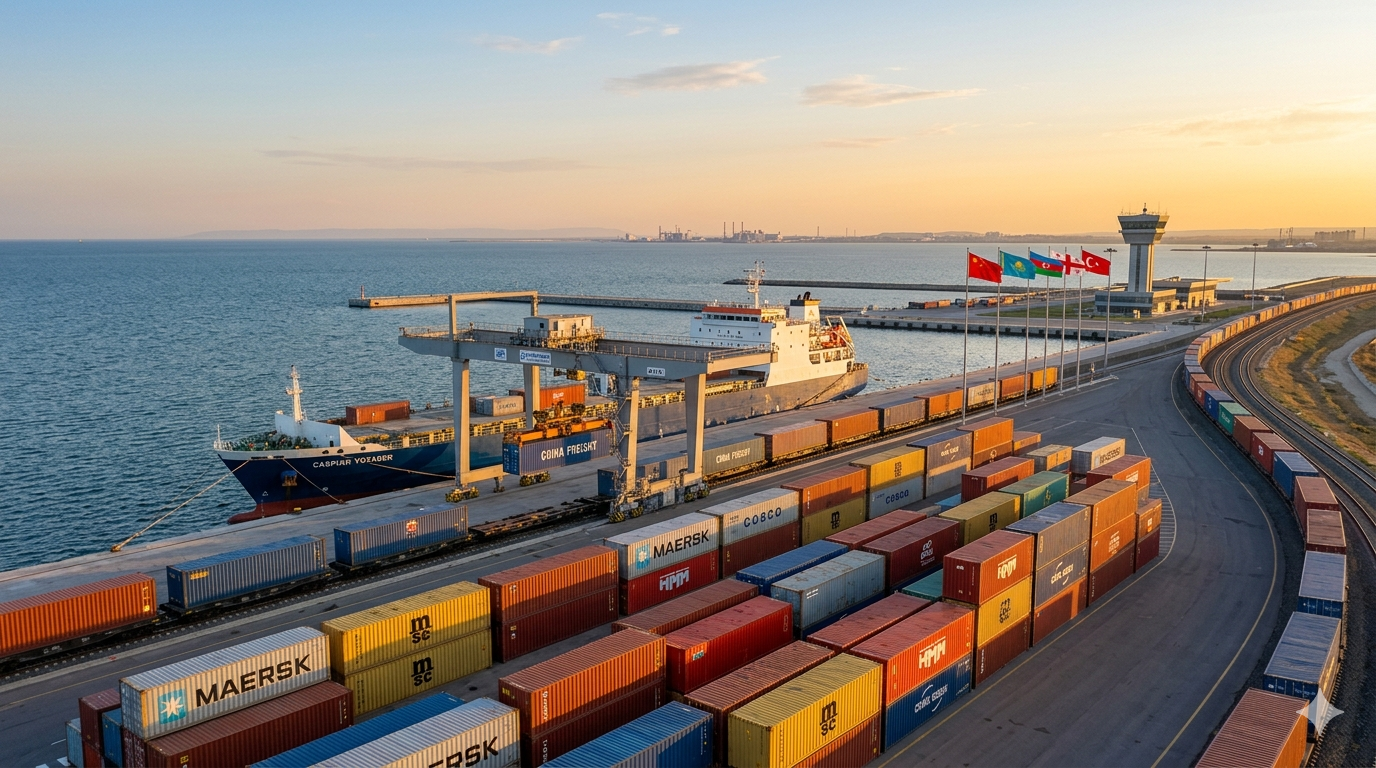
- The Caspian Sea Bottleneck: Trains arrive at the Kazakh ports of Aktau or Kuryk, where containers are transferred onto specialized roll-on/roll-off (Ro-Ro) vessels or cargo ferries.
- The Caucasus Transit: After crossing the Caspian Sea, vessels dock at the Port of Baku (Alat) in Azerbaijan, where cargo is reloaded onto trains or flatbed trucks.
- European Entry: Shipments move along the Baku-Tbilisi-Kars (BTK) railway through Georgia and Turkey, or cross the Black Sea via Romanian and Bulgarian ports into central Europe.
Middle Corridor Performance Analysis: Time vs. Cost
For corporate supply chain officers, selecting an international freight route requires a strict evaluation of cost efficiency versus transit speed. Below is an operational comparison of the Middle Corridor against traditional global trade routes based on data from Q1 2026.
| Trade Route | Average Transit Time | Estimated Cost (per TEU) | Core Risk Factors |
|---|---|---|---|
| Middle Corridor (Rail / Maritime Hybrid) | 15 – 19 Days | $5,500 – $7,000 | Infrastructure bottlenecks; weather delays at sea |
| Traditional Ocean Freight (via Cape of Good Hope) | 35 – 45 Days | $3,000 – $4,500 | Extended transit times; maritime security threats |
| Northern Corridor (Trans-Siberian Rail Network) | 11 – 14 Days | $4,500 – $5,500 | Sanction non-compliance; insurance exclusions |
Transit Time Improvements
In its early stages, the Middle Corridor suffered from volatile scheduling, with transit times often exceeding 40 days due to customs friction and port congestion.
However, multi-national infrastructure investments have successfully streamlined operations. By Q1 2026, transit times from western Chinese borders to European rail terminals have stabilized to between 15 and 19 days, making it twice as fast as ocean freight.
The Freight Cost Premium
Speed and geopolitical compliance come at a premium price. Moving a standard container through the Middle Corridor costs between $5,500 and $7,000. This reflects a 35% to 50% price premium over ocean freight.
This added cost is entirely driven by multi-modal transshipment fees—specifically, the physical labor and equipment costs required to lift and shift containers between trains and vessels at the Caspian and Black Sea ports.
Geopolitical Capital: Funding the Infrastructure Upgrade
The Middle Corridor is evolving from an emergency detour into a permanent, institutionalized trade artery. This transformation is fueled by massive injections of public and private sovereign wealth:
- European Union Backing: The EU has committed to mobilizing €10 billion under its Global Gateway initiative to develop transport links, digitize customs processes, and upgrade rail infrastructure across Central Asia.
- China’s Belt and Road Initiative (BRI): Beijing continues to fund physical infrastructure, focus on expanding the capacity of the Baku-Tbilisi-Kars (BTK) line, and supply automated container tracking software to regional ports.
- Unified Bureaucracy: Kazakhstan, Azerbaijan, and Georgia have established joint logistics ventures to implement a single, unified digital bill of lading, eliminating duplicative paperwork at national borders.
Strategic Action Plan for Cross-Border Shippers
To successfully implement the Middle Corridor into a corporate logistics strategy without compromising profit margins, freight forwarders and shippers should execute this three-part playbook:
1. Segment Cargo by Profit Margin and Urgency
Do not route low-value commodities through this corridor. Reserve the Middle Corridor for high-value, time-sensitive freight where a delay causes severe production line stoppages or missed retail windows. Ideal cargo includes:
- Automotive electronics and sub-assemblies
- Lithium-ion battery components
- High-end industrial machinery
- Fast-fashion apparel and seasonal retail goods
2. Secure End-to-End Intermodal Contracts
Because the route crosses multiple borders and changes transport modes, standard shipping contracts can leave gaps in liability. Shippers must negotiate comprehensive Through Bills of Lading (TBL) with tier-one freight forwarders. This ensures a single logistics provider assumes liability across the entire multi-jurisdictional journey.
3. Maintain Financial and Buffer Timelines
While infrastructure updates have stabilized transit windows, the Caspian Sea remains prone to seasonal winter weather delays. Supply chain managers should build a 15% timeline buffer and factor in contingency capital to absorb potential demurrage and storage fees at transshipment ports.
Conclusion: The New Era of Resilient B2B Sourcing
The rapid rise of the Middle Corridor is a definitive look at the future of global commerce: multi-modal, highly digitized, and structurally built to withstand continuous geopolitical disruptions. For forward-thinking B2B enterprises, mastering this route is no longer just an alternative shipping option—it is a critical strategy for global supply chain resilience.